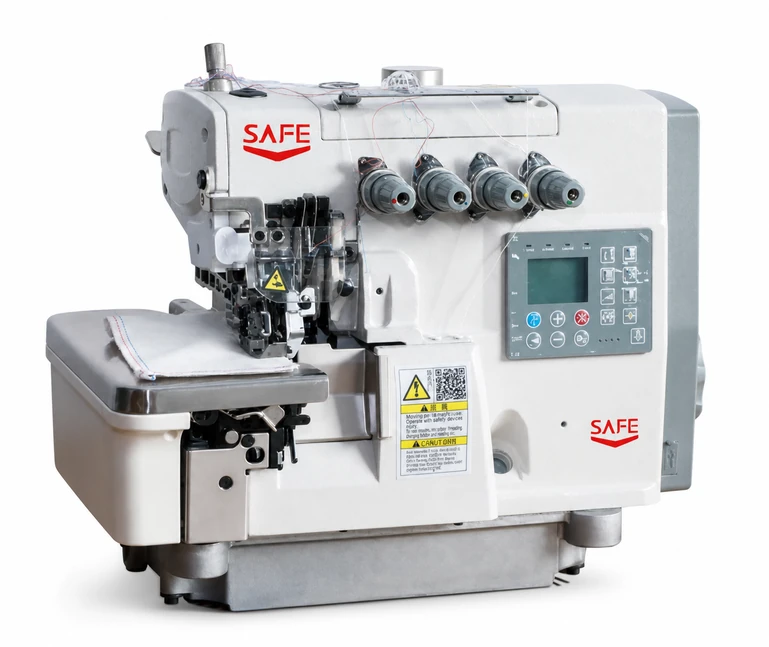
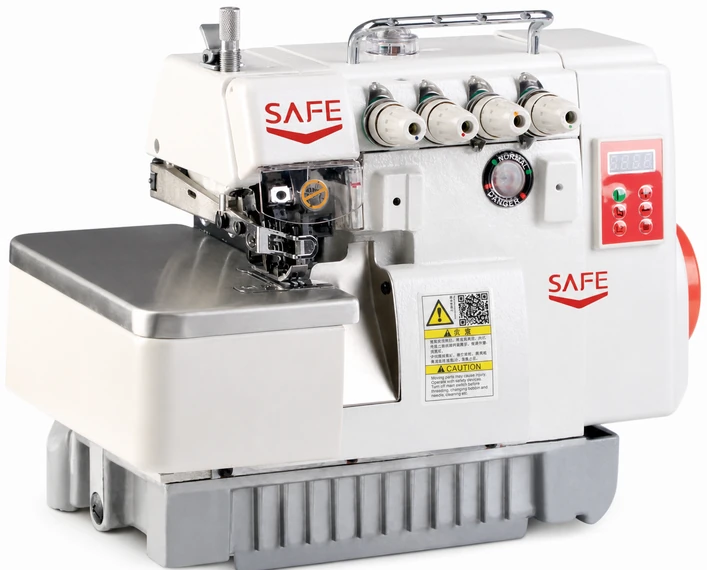
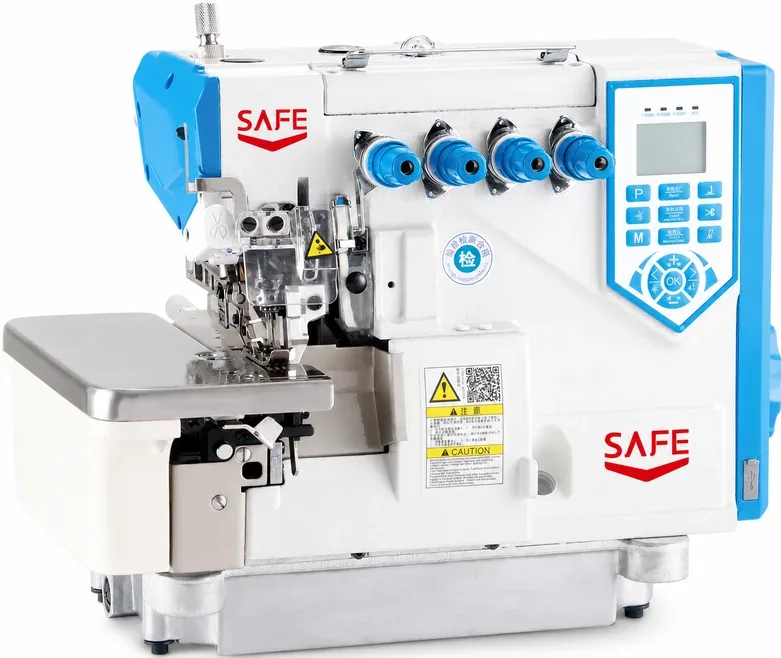
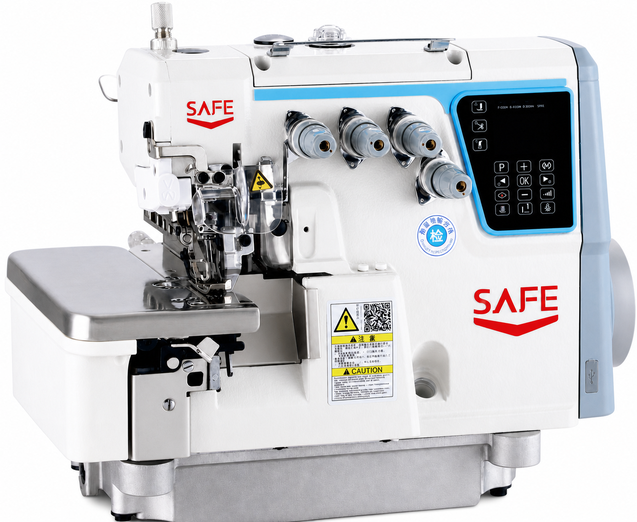
The SAFE SF-747D-4 is a two-needle, four-thread industrial overlock machine for garment seam and edge operations. Adjustable differential feed and a 4 mm overedge width give buyers a defined starting point for sample testing.
SAFE 747D series catalogue image. Confirm the four-thread configuration when ordering.
Product features
Built around the sewing operation.
01Two needles and four threads distinguish this model from the three-thread and five-thread versions in the 747D range.
02Differential ratio of 0.7–2 supports feed adjustment for the material being sewn.
03Stitch length is adjustable from 0.5 to 3.8 mm, with a listed 2 mm needle gauge.
04Maximum catalogue speed is 6,500 rpm. Choose the running speed around the material and seam requirements.
Applications & catalogue details
Check the material, seam and handling.
Overedge joining and edge finishing on garment panels.
Knitwear seams where a two-needle, four-thread construction is specified.
Repeat garment work requiring control of fabric feeding and seam appearance.
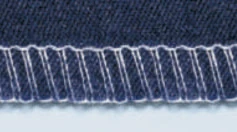
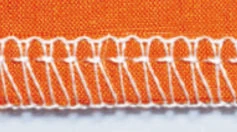
Send a material or finished-seam sample to confirm the configuration. Catalogue examples illustrate the operation; the required result should be agreed before ordering.
What is the difference between SF-747D-3 and SF-747D-4?
The -3 version lists one needle and three threads. SF-747D-4 has two needles and four threads, a 2 mm needle gauge and a maximum speed of 6,500 rpm.
How should I choose an industrial overlocker for knitwear?
Send the fabric, number of layers, seam drawing and required finished width. Differential feed should be set and assessed using the actual material.
Does this model include automatic thread trimming?
Automatic trimming is not specified for this model in its catalogue table. If trimming is required, compare SF-EX5200-4AT or ask for the exact supplied configuration.
Ordering & technical support
Prepare a configuration-specific enquiry.
Send the model, material, seam or operation, quantity and destination. For automated equipment, include the workpiece dimensions and current handling steps.